Showing posts with label librarians. Show all posts

Friday, October 21, 2011

10 easy steps to a fantastic future for libraries

10 easy steps to a fantastic future for libraries.
If we can we be:
• leaders in our community
• leading by doing
• proactive and engaged
• listening and forward thinking
• open and communicative
• learning and changing
• trusting and tolerant of failure
• free to experiment and play
• sharing our knowledge and skills
• creative and connected

Maybe easy isn't the right word but IMHO I think it's what we could be doing to create a strong and vibrant future. These 10 easy steps can be applied to any library context and then comes the hard part - where you put it  into practice! This year I've been to a few events focussed on the future of libraries and the future of the profession and reflecting on those events helped me come up with this list. You may agree or disagree, I'd love to hear what you think?

Thursday, June 23, 2011

The importance of great leadership

While convalescing last week I was thinking about how important it is to have strong, supportive leadership in the workplace. As a newbie in any career, you rely on supervisors, managers and superiors to mentor, guide and lead. Under the right conditions you can flourish in your role and be rewarded. Under not so right conditions your self esteem and sense of purpose can plummet. In my worklife so far I've experienced both. I've worked in places where I didn't feel I could speak up and voice an opinion, where hard work is not acknowledged or rewarded, where new ideas are discouraged, where every move is scrutinised, or worse, where you are completely ignored and disregarded. Luckily those time are behind me because where I am now is the complete opposite. I am so grateful to be in an environment that is supportive, encouraging, innovative and engaging. I feel like I'm part of a team that includes all levels of staff with many different backgrounds, talents and interests. I've learned so much from all my supervisors and managers (and the whole team) about communicating, working together, planning, organising and teaching. I know I might not always be so lucky, but I hope I've learned enough from current and past experiences to realise when I'm not flourishing and to move on before my self esteem plummets. Of course there are good days and bad days in any workplace. But hopefully the good outweigh the bad. If they don't it could be an indication that it's time to spread your wings elsewhere.

Friday, December 3, 2010

Making sense of transliteracy?


A gift from my sister: owl glasses holder
 Information literacy dressed up in sheeps clothing?

I'm a sucker for buzz words and the new one in libraries is transliteracy, described as the ability to read, write and interact across a range of platforms, tools and media . AACL recently featured an article attempting to demystify the concept for those who find it difficult to grasp and not long after a witty response popped up via Twitter.

Some argue this new buzz word is just a way of describing what libraries have always called information literacy because it basically means using new tools to understand, find, evaluate, use and create information. In many of my blog posts and papers written this year I’ve talked about the need to support 21st century learners and therefore build 21st literacies. My focus has been on supporting the physical, digital and mobile worlds of our clients including making use of social media to connect with them informally in their online communities. Some might call this Library 2.0 but I  think it's just common sense to understand your clients and support them accordingly. This year I've been involved in many projects to reinvent our information literacy programs with a Fun Day, new workshops, treasure hunts, games, and mobile technology. This has taken considerable effort from a team of keen librarians who are committed to experimenting and playing with new technology in order to understand the information worlds of our clients and develop new services and support to meet their needs.Transliteracy seems to be the answer some people were looking for to make this easier and I wonder if it's already happening intuitively without the need for a buzz word?

A recent PEW internet report describes 21st Century learners as ‘networked learners’ who embrace new technology, mobile devices, gaming and social media as part of their information landscape. Obviously these people are making use of multiple platforms to read, write and interact. Is this transliteracy? Since Web 2.0 has created a blurring of the lines between work and play, we now use these platforms in multiple contexts of everyday life. I wonder if we are supposed to be transliterate at work or play or both?

I think in an everyday life context, transliteracy is easy to grasp – basically you get the main idea of something and apply it to other platforms. For example, in a previous post I wrote about a radio interview by Kathryn Greenhill who spoke about transliteracy in terms of the way her kids make sense of their world. They read Harry Potter books, watch Harry Potter movies, play Harry Potter Lego, play Harry Potter video games, dress up as Harry Potter – what more can there be? I’ve also spent too much time with friends drawing Hogwarts and dreaming Harry Potter dreams. This isn’t necessarily reading and writing but it is interacting across a range of platforms and making sense of information by embodying the experience. To me this seems like a better way to understand transliteracy - the ability to interact and make sense across a range of platforms.

I think transliteracy is harder to define in an academic context. Does it mean students can effectively use collaborative tools like Google docs to work on group projects , share files using Dropbox, find scholarly information such as books, journal articles, videos on YouTube, images on flickr, journal articles, webpages and create interactive multimedia presentations? How is this any different from what’s already happening? Perhaps it is more to do with the ability to find information in books, ebooks, journals, websites, blogs, video, images, social networks, and friends to effectively filter and evaluate that information and then create new information using appropriate tools and media? Is that any different? This second scenario places more emphasis on evaluation rather than just using the tools which has long been considered the more important of the two.
Another option is to harness the networked learner idea and combine it with the idea of Web 2.0 blurring the lines. Can we combine the work and play context to have one everyday life context that makes use of new technology, old technology, mobile devices, gaming and social networks to read, write, interact and make sense, therefore creating the ultimate transliteracy? ELT – Everyday Life Transliteracy? No more separation between how I make sense of the world at work and play. Worlds are merged and transliteracies are merged. This is what I think the 2010 ANZ Horizon report is getting at when it describes supporting students as they move from study to the workplace: (sorry for the long quote)
The need for formal instruction in key new skills, including information literacy, visual literacy, and technological literacy, poses a continuing challenge to educational programs. As noted a year ago, students need — and often lack — a strong understanding of content and media design, the ability to interpret advertising and other media, and the capacity to create multimedia messages that demonstrate visual fluency. A handful of institutions have begun to integrate the teaching of these skills into a standard curriculum, but the practice is not widespread and too many students remain unschooled in this critical area.

In today’s networked world, learners are placing greater value on knowing where to find information than on knowing the information themselves. The ways we learn are changing. The amount of knowledge collectively held by humanity is staggering, and being able to find, evaluate, and synthesize material from a variety of sources is arguably more important than holding much of that knowledge oneself.

Young people beginning postsecondary study — and those entering the workforce — are accustomed to constant access to a network of peers on whom they rely for knowledge, expertise, and mutual learning. This cohort may well expect to be able to make use of their own personal learning and social networks, and the technologies that support them, in their places of work or study. Their world is open and mobile, and they expect access to it constantly.

I think this extract emphasises that support and instruction is needed for students to develop a strong understanding of how to build transliteracies. Libraries are well placed to  provide training and support through traditional face-to-face and online modes but we also need to think of new ways of supporting students through social media and mobile technology. I also see an opportunity for us to share our expertise and collaborate with academics who are interested but not experts themselves in these areas. The extract also point out the need to prepare students  for the future workplace. Students need to seamlessly move from study to the workplace with the ability to read, write, interact and make sense across a range of platforms. Whether or not we call it transliteracy is irrelevant. If we don't get to know and understand our clients we/they don't stand a chance. We're hearing it all the time - they want flexible, open, spaces with ubiquitous access and support. So for one last time this year, I encourage you all to experiment and play in order to understand your clients and develop new services to meet their 21st century needs.

Saturday, September 11, 2010

What I learned at Library Camp

from aliaaccess flickr group: snail's trail
On the last day of ALIA access 2010 I joined fellow campers in a great day of participatory library fun. ADHD_librarian, snail and the many other people involved did a fine job of running this unconference and my first ever library camp. They got me in simply by calling it a camp and creating expectations of fun, laughter, noise, stories, games, singalongs, dancing... there was no dancing but I wasn't disappointed. There were very few sit and listen sessions and from the start people were freely calling out thoughts, ideas and opinions. I loved the structured unstructure of it all. The camp wiki was our program for the day and I love that it changed and morphed as ideas for breakout sessions ebbed and flowed. I loved the beanbags but I agree with @dendrea that the room was a bit restrictive and didn't allow much moving about and getting comfortable, camp style. All in all it was alot of fun and there was a great buzz in the room all day. I was telling a friend about library camp this week and they asked 'did you actually camp there'?

So what did I learn at Library Camp? I loved Stephen Abram's presentation "Not the Keynote" (on slideshare) which described the internet and ebooks as in their 'infancy'. Such a good analogy. Both still have such a long way to go to reach maturity with great changes expected to continue for many years. There was alot of talk at the conference and camp about the future of reading and books with regard to personalisaton and digital rights management (DRM). 'Read how you want' was a trend that came up many times and applied to both print and digital formats. In Abrams unkeynote I tweeted 'we love books but we don't care about the container'. I also tweeted 'I'm excited about the 21stC book experience' with the possibility of Harry Potters spellbook becoming a reality! While I'm excited about how books will change and become more interactive, I actually do care about the container. I think it was flexnib and katiedavis who tweeted that they care about the container when they can't get the content they want on their container. I agree wholeheartedly, this is a very annoying DRM issue - which became a late addition to the final camp breakout sessions. You can have a great container but what is the use if you can't get what you want on it? Publishers need a more open and flexible approach that allows users to 'read how they want'. I was on a 'Loungin around' panel session after lunch and one of the questions was about print on demand books. I suggested that currently ebooks supplied to academic libraries are so restrictive that they can't be downloaded to a mobile device for better screen reading and often only one page or one chapter can be printed to allow mobility. This needs to change. However, this could take a while and in the meantime print on demand will allow users to print the chapter they need, 24/7 so they can read anywhere anytime. Printing allows mobility just like any other mobile device and until publishers change the way they allow their content to be used, print on demand will be necessary.

There's another reason why I care about the container. I recently acquired an iPad and really enjoyed reading on it however, I've discovered that I still desire of the object, I miss the physical book (I'm a bit of a collector). I love to hold the book, absorb the cover, and see it on my shelf as a reminder of how it affected me and shaped my thoughts. Now my ebooks are on my iPad shelf and it's not the same. So I think, if I'm reading something trashy that I don't really want on my physical shelf, I'll go for the ebook but if I think I'm gonna love it and want to hold it and gaze at it I'm gonna buy the paper book. So for me, the container does matter. IMHO I think it matters to other people too and I think ebooks and print books will coexist happily for a long time.

So that was one thing I learned at Library Camp and there were many others... I'll try to be more succinct. I loved that Abrams said we need to consider the community, learning, entertainment, social and research purpose of the library - it's not just about books. He also said we need to be present in social spaces of our clients so we can collaborate in their learning.

After Abrams we had a great talk by 2010 Library Journal 'Mover & Shaker' Paul Hagon from the NLA who debunked mobile myths and talked about that fast paced changes that have occurred in the online and tech worlds in the last 5 years. Interesting that only 4% of Aussie kids use a mobile to access the web (much lower than USA) and most of them are just accessing Facebook. Also interesting is that most people access the web on their mobile to find simple info such as directions, restaurants, weather, movie times etc. He noted that the NLA website gets only about 0.5% of its traffic from mobile devices. Best of all Hagon encouraged us all to think small, get dirty, experiment and play to learn about new tech and see what the potential is. I'm not being very succinct am I? There's more...

I loved all the lightening talks and found these little snippets really got the mind juices flowing and I was wishing I could hear more - so tantalising. I'm excited about the ALIA sustainable libraries group, enthused about social media in libraries, excited by the future of personalisation and impressed by the use of an iPad to give a presentation on how awesome the iPad is. That was my lightening paragraph on the lightening talks. I haven't even started on the breakout sessions! But me thinks that is enough for now. I certainly have a lot to ponder and will try to share more of my thoughts on Library Camp soon. Can't wait for the next one!

Friday, September 10, 2010

Librarians on tour at ALIAaccess

Last week I attended ALIA access 2010 in sunny Brisbane and the first day kicked off with various site visits to Brisbane area libraries. I was on the Brisbane city walking tour with a great bunch of people and we visited QUT library, Brisbane City Square Library, State Library of QLD and Southbank Institute Library. I was wearing my pedometer because I'm doing 10,000 steps with some colleagues at the moment and by the end of the day I'd walked well over 20, 000 steps! Yes, we were a tired bunch of librarians by the end of the day but totally excited and blown away by all the things going on in the libraries we visited. I got into quite a frenzy taking photos which I've put on flickr and embedded below. You can see from the photos what I was most excited about but overall I think there were a few trends:
  • More support for multi-media in terms of consuming and creating e.g. there were listening stations, media lounges, digital story pods, editing suites, COWS (computers on wheels) and more!
  • Open learning spaces with natural light and creative use of space, technology and furnishings
  • Creativity in the library - displays of library community art, design, objects, crafts, jewelery, etc.
  • Library as social and community hub with a range of related support and assistance available such as IT, photocopying, city council offices, academic literacy support
Enjoy!


Transforming information literacy through experimentation and play

Last week I attended ALIA access 2010 in Brisbane and gave a presentation in the information literacy stream. The presentation was based on the paper written by Jemima McDonald and me titled: Transforming information literacy through experimentation and play. The presentation illustrated some of the ways UTS Library is creating a more dynamic and engaging information literacy program in physical, digital and mobile spaces. Some of the things we're using are games, vodcasts, podcasts, screencasts, Facebook, Twitter, YouTube, flickr, blogs, QR codes, interactive teamboards, fun days and hands on workshops! Toward the end of the presentation I emphasised that none of this would be possible without the hard work and enthusiasm of all the staff at UTS Library who are willing to experiment and play to make all these projects a reality. The presentation was created in prezi and includes animations created using xtranormal.


The idea behind all of this is that Web 2.0 has changed the way we engage with information. Information is now everywhere created by everyone and we need to transform our information literacy programs to better support the 21stC learning, teaching and research of our clients in their information worlds. Not only online but in physical and mobile spaces by understanding the concept of Library 2.0 which is about users, participation and interaction (Luo, 2009). If you're interested, I recommend reading the paper - it's not too long!

We've had a lot of great feedback about the presentation and genuine interest in what we're doing at UTS Library. I'd like to thank everyone who came to the presentation and shared their thoughts with me at the conference. I also have many people to thank for their help in making this presentation happen. Firstly, my co-author Jemima for all her hard work and support through this experience from initiating and leading many of the projects, to abstract submission, paper writing, presentation creation and presenting! Thanks to Sally for help with the abstract, making the projects happen and grilling me with potential questions, Belinda for super quick editing, Mal for reminding me I'm from UTS Library and that means no rules,  Ashley for being my spirit lifter and helper in all things, Fides for beaming at me from the back row and Alex for his leadership in all of this and trusting a newbie like me to represent the Library! Finally I'd like to thank all the staff who've made it all possible. This is becoming a bit of a love fest but I really want to express how much I appreciate the people I work with. They're a great bunch!

Saturday, August 14, 2010

Intro to podcasting workshop

A couple of weeks ago I was asked to run two short introduction to podcasting workshops for academics so they could understand the basics of how to create a podcast. In 30 mins I managed to give them an overview of the pedagogy behind podcasting, we discussed how they could use it in their teaching and we recorded, edited and uploaded a podcast using an iphone (voice memos app), mac and audacity. Quite a feat! There were about 10 in each group and none of them had tried making podcasts before. Overall, the response was very positive and they all felt it was something they could now have a go at. I told them I'm a very lazy podcaster and gave them all my tips for making a podcast quickly without worrying if it's perfect. One of the participants had just been to a screencasting workshop and asked why you would podcast when you can screencast? I said that it depends on what you need it to do. In a library we're often teaching people how to use databases which is better explained through a screencast that provides a visual demonstration. However, for teaching you might be explaining ideas, concepts and theories that don't necessarily NEED visuals. In that case you can make a podcast. Of course you can put slides or other visuals to accompany the podcast if you wish. The other reason for making a podcast is because you can easily put it on your ipod and listen on-the-go, on the bus, in the car etc. which is not as easy to do with a screencast.

Here's the handout I made for them using prezi. All I did was make it as a single view in prezi without any zooming path and then when you hit print, it saves as a PDF and you can print it out as a handout. Much more exciting than a word doc handout!


So here's my intro to podcasting:
1. Have a reason for it. Ultimately it has to add value in some way.
2. Plan what you're going to say. Either rough notes or more scripted. Keep it short,  simple and to the point. Between 5-20 mins is best but keep it as short as possible.
3. Find a recording device. Either an iphone or ipod with mic attached OR a USB mic plugged into a computer with audacity open
4. Start recording. Keep mic close to your mouth, record in a quiet place, don't worry if you cough, sneeze, say ummmmmmm, make a mistake or swear - this can all be edited out VERY easily. Just keep going. Even start a section again if you want. (Maybe do a short test first time to check the sound isn't too loud or soft).
5. Speaking tips - speak slowly, clearly and use your voice to provide emphasis and sell what it is you're trying to say.
6. Plug your device into a computer and open the sound files in audacity. If you plugged a mic into audacity you're already there.
7. Listen to what you recorded and identify any bits you want to delete. Simply click and drag to select and then hit delete. Easy!
8. 'Normalise' the file for better sound quality - this can take a little while. Don't worry if you forget.
9. Save as a compressed file so it's a smaller file and quicker to download
10. Export file as MP3 or WAV and save
11. Upload to Learning Management System or somewhere sensible for easy access
12. Even better if people can subscribe to your podcasts via RSS so they automatically download to iTunes.

Here's a screenshot of audacity which is the free audio editing/recording software I used and available for mac or PC. I think it's easier to use than garage band for podcasting.
Image from flicke by npslibrarian

Have fun podcasting!

Thursday, July 29, 2010

Information literacy in context

Today I'm considering what information literacy in context means and why it is important. I believe first and foremost that it's important because information is experienced in socio-cultural context and outside this information has no meaning. I work in an academic library which means the context of IL I'm dealing with is a tertiary education setting in which information literacy instruction is delivered in accordance with the Australian and New Zealand Information Literacy Framework with the aim of enabling individuals to know when information is needed and identify, locate, evaluate, organise and effectively use the information to help resolve personal, job related or broader social issues and problems (Bundy, 2004: 3). However, most of the time in academic libraries those wider contexts are forgotten and all that is addressed in instruction is the immediate context of formal education. By that I mean IL instruction that transfers generic skills and attributes such as how to find a book or use a database. Those skills are necessary in a formal educational setting but are they transferable to wider contexts? Possibly, however the context in which learning these skills occurs could dramatically influence the outcome. What I mean by that is the p word, 'pedegogy'. If academic libraries consider IL instruction in the context of everyday life information seeking rather than purely in the context of formal education then we have a real chance of achieving the goal of creating lifelong learners.

Web 2.0 has created a blurring of the lines between formalised learning and informal play. That means curriculum has changed and now learners are expected to be active content creators engaged in collaborative projects in both physical and digital space. Is our information literacy instruction supporting learners in this context? Does the framework apply? Traditionally, IL instruction would provide learners with the skills to find information relating to the content they need to create but I believe we have an opportunity to move beyond that and provide skills in how to create and share content collaboratively. Lee Rainie considers so called 'digital natives' to be networked learners who embrace new technology, mobile devices, gaming and social media as part of their information landscape. If we want to support learners in the 21stC we should take up the challenge and provide new IL programs supporting this changing information landscape.

Getting back to context. I believe IL instruction should be situated in an everyday life context so learners can apply their experiences to formal and informal educational settings. If learners can apply IL instruction to formal and informal learning environments we may be able to achieve the elusive goal of creating lifelong learners. For example, there is an abundance of literature about students prolific searching of google over library resources. Why not teach them to use google more effectively so they can evaluate results and find more scholarly resources? (In doing so they may better understand the weaknesses of google and the strengths of library databases.) This provides them with skills they can apply in formal and informal contexts in everyday life.

I also believe there is context within context. (Has anyone seen Inception?) Within an everyday life information seeking context there are socio-cultural contexts to consider when planning IL training. For example, an academic library IL program might be three tiered consisting of: generic skills, subject specific skills, assignment specific skills. When teaching subject or assignment specific skills is there a way to apply an everyday life lens so the experiences can be applied to formal and informal settings? I believe we can achieve this by understanding the needs of learners and the socio-cultural context of their learning.

Summing up. Learning occurs through formal and informal means knowingly and unknowingly throughout life. If we embed IL training in an everyday life context learners can apply these experiences to formal and informal settings and perhaps achieve the goal of lifelong learning.

Wednesday, July 28, 2010

Library day in the life

I just had a week off after a really busy period at the library and I've returned to an equally busy period. All my own doing because I'm constantly coming up with ideas for new and fun things we should try. All these things seem to be coming to fruition at the moment including writing a paper for InfoOnline 2011.  This 5 min Library day in the life video gives you a bit of an overview of what's been going on. I even show you my new owl badge and my ipad. It was made using photobooth on a mac and then I edited in imove. All I did in imovie was add the opening and closing credits and edit out me coughing. So easy!


The next week for me entails: vod/screencasting and editing, writing lesson plans, teaching IL classes, writing a paper, demonstrating podcasting, hosting a visit by a visiting academic, doing library tours, meeting with academics, law database training, meeting with special needs students.... is that all?

I keep promising myself that I'll get better at not doing 'too much'. I don't seem to be getting better at it yet but I still have hope.

Wednesday, June 30, 2010

Response to @zaana's post on designing workspaces conducive to work

Does an orderly desk = an orderly person?

Like many libraries at the moment we are gathering ideas for a new library building and part of that is thinking about work styles and how that translates as staff workspaces. The google offices have been thrown into the mix and of course we all go why can't we have that? @zaana's post Designing workspaces conducive to work got me thinking. Do we really want that? I certainly like to make my workspace feel like mine by putting up pictures and having tea paraphernalia strewn everywhere but that's it and I think my space is conducive to work. Could it be more conducive? Seeing those google offices I think, what if we had a 'break out area', gym, chef, wii games, espresso machine, ball pit and fairy floss machine? What next? I want a pony! Don't stake me but I think I'd get really distracted by all those things and be a bit less conducive. I guess my work style is 'block out distractions cause you're easily distracted by flashing lights and a ball pit'. What's yours?

While the google example is a little bit overwhelming for me, I find the Macquarie scenario @zaana describes terrifying! Always competing for a space, not feeling like you belong anywhere. I understand the desire to be mobile but that's ridiculous! @zaana didn't seem too against it and I noticed in the comments that someone had tried it in their workplace and thought it really encouraged collaboration so I guess it suits some work styles?

Can we find a balance? I believe we need a flexible, creative workspace that is conducive to work without distracting us. Just like a library, our workspaces need to facilitate noisy group work and quiet individual work, encourage collaboration, innovation and lifelong learning. Just like a library it needs to feel like 'our' space where we feel comfortable and at home. It needs to inspire and motivate us to work and efficiency will follow. We need multi-media editing suites to be expert content creators and comfy places to contemplate new ideas. Recently the librarians here said they want space to 'play'... I guess the problem is finding a way to translate these things into physical space and not just by having colourful walls and funky furniture. I would really like to work in a tree house though...

Monday, June 28, 2010

Why am I a librarian?

This is a response to @gigglesigh's and @fionawb's question, 'why am I a librarian'? I've only been a librarian for two years and I guess the why part will keep changing over time but right now this is what I've come up with.

I started my academic life at art school which involved trying to force order onto chaos and disarray. It can be hard to organise creativity and I don't think I was very good at it back then. At some point I turned from Sculpture and installation to printmaking and I think this was a turning point that in part led to my becoming a librarian. Why, I hear you ask? Well, printmaking is a very precise skill involving etching with acids, resins, fine tools, inks, and papers. I learned to examine every detail of an etching and organise my sketches, ideas, tools, and supplies with care. I became a master at the craft and loved using my skill to create new effects, layers, images, ideas. It was the precise and detailed nature of the work that I loved and I think is one thing I love about being a librarian. I started teaching printmaking after a while and loved sharing my experience with students. This too is something I love about being a librarian.

After art school I worked in a new and 2nd hand bookstore for many years. It was a great part-time job with great people, flexible hours and an endless supply of books! I loved reading, looking at, touching and smelling books. Talking books with customers and colleagues was a real pleasure but above all I loved helping customers find what they were after (another thing I love about being a librarian). Being a second hand dealer, you have no idea how obscure some of the requests would be. But I'd wander through the shelves searching and sure enough find a book on a rare breed of poultry or a historical figure of Tibet. It was during this time that I decided I needed to do something more with my life. I felt I had more to offer (society? the world?) and needed a new way to express that. I thought to myself, what do I like? and the answer was: books and helping people. So I thought: I should be a librarian. So naive.

So it was that I started 'library school' and discovered that the idea I had of a librarian was long gone. Thank goodness because I soon embraced my new notion with gusto. I really loved studying so much more than I had the first time. I was learning new things everyday and consuming it all like I'd woken up after a long deep sleep. By halfway through I thought there are so many jobs I could do after finishing - one of my last choices would be librarian. However, after some work experience in a public library I wasn't so sure. I enjoyed helping people and felt a sense of purpose but there was still something niggling at me. I wanted more...

After finishing my studies I worked in a social research centre library for a while and really loved supporting researchers, building databases, websites, teaching them skills, and all the basics of librarianship. The only thing was, I was the only librarian and felt professionally lonely. Being a newbie, I felt I needed to be around other people so I could learn more and be supported and encouraged to find my feet as a librarian.

Now I'm at an academic library and loving it. I feel like I'm in the right place at the right time. What I currently love the most is: helping people learn new things that will help them (staff or clients), feeling supported and encouraged by a great bunch of colleagues, sharing ideas and making ideas a reality, constantly learning new things, meeting like-minded librarians through social media and conferences all over the world, pondering the future of the profession and libraries. That might seem a bit vague but it means a lot to me. I know I've been lucky in my short career. I can only hope my luck continues!

Friday, June 25, 2010

Behind the scenes fun

Two things I enjoyed behind the scenes at the library today. We have a whiteboard in our staff tea room which is usually not used very much. However, last week someone wrote on there - 'what are you reading'? The board is now full of all the books people are currently reading! While it is anonymous, I really like seeing what else is being read by people I work with. I also like to see a participatory spirit in action and it's been exciting seeing the list grow all week. It's great to see that someone has added 'tags' to the list, well only one tag - (vampire)!

Secondly, also behind the scenes: I'm currently participating in the 10,000 steps challenge with an all library peeps team. We only started on Sunday so we're sill keen-as and rearing to go (well a few of us are anyway). Today we went walking at lunchtime and it was really fun to get out, be active and have some fun in the fresh air! You should try it! I can also recommend a well deserved pitstop on one of these walks - even if the walk is only 30 mins - you need to hydrate!

Friday, June 18, 2010

Scenario building for the Library of the Future


There is so much speculation about what the future will bring for libraries. Just last week this blog sparked a string of comments about the many optimistic/pessimistic views of possible future scenarios. I thought I'd look into it a bit more and here's a few things I found.

This article by Marcum from 2003 looks at the library of 2012. Only 2 years away and I think he's done a great job of putting a pretty out there vision of the future forward. Marcum thinks we'll be Cybrarians in InfoSpace which is dominated by 'multiple-media' and utilising video-displaying walls, situation room theaters, learning "cafeterias," dispersed, theme-centered constructions and multi-media "books". Does anyone else think 2003 sounds really long ago? Weren't ebooks on the horizon yet? I guess the vook has only just become a reality?

In 2004 IFLA published Defining Information Literacy in the 21st Century. The scenario they imagine is: Libraries are no longer the primary source of information, we will not be dealing with clients face-to-face, information literacy with be client driven which they see as point-of-need and just-in-time, and evaluation will become more important. At the time this was written it might have been considered radical? But I think alot of this is (and probably was) already the case. This scenario is now. We want to know what you think will happen next?

In 2006, Futurist Speaker put forward some suggestions for libraries wanting to transform with the changes that confronting us and recommends: evaluating library experiences, embracing new technologies, preserving the memories of our communities, experimenting and being creative with space and the role of the library. He emphasises the need for creative spaces and suggests: band practice rooms, podcasting stations, blogger stations, Art studios, Recording studios, Video studios, Imagination rooms, Theater-drama practice rooms (dancing rooms - Mal that was for you). Pretty good stuff huh!

This year at #plff2010 the State Library of New South Wales launched the Bookends Scenarios which goes into great detail about scenario planning and the process they went through in coming up with a matrix of four possible future scenarios for public libraries. I was at the panel discussion for the launch of the report and there was much disagreement over each scenario and the plausibility of each one. Pretty much all of them had both optimistic and pessimistic elements which I think is where the problems were born. The optimists couldn't imagine the negative things in the scenario occurring while the pessimists obviously felt the opposite. Can we ever bring the two together? SO what were they?

No.1. Silent Spring: Climate change has ravaged the world and due to resource shortages the only place people can access technology and resources is through the library. There is move back to print based products and a more local approach to community life. It' seems a bit like when your mum decides you won't have TV for a year when you're a kid and everyone bonds and reads books and feels better about themselves and the world. NOT GOING TO HAPPEN! (oooh that sounded cynical!)

No.2. How Buildings learn: technology overload has created a fast-pased globalised world of digital everything. Information overload has made everyone uneasy (who?) and libraries have become community centres, cafe's gyms, etc and vital in helping navigate the information overloaded digital world... not sure how I feel about this one. It doesn't seem all that far away from what's happening now - except for some reason it makes me feel uneasy.

No.3. Neuromancer: The world  gone mad, everything is in short supply and prices are sky high due to big corporations creating, owning and controlling information! People have to go to the library because they can't afford computers or Internet access. I think this is the least likely of all the scenarios. User- generated content cannot be stopped and with open source, open content movements on the rise I don't think it's reasonable to think that big corps will suddenly create, own and control everything. Hang on... what am I saying... Google... Apple... etc...

No.4.  Fahrenheit 451: "A screenagers paradise" with physical books almost dead this is a post-literate world where digital is all. For some reason in this scenario libraries struggle due to funding cuts and in desperation they start mental health gyms, screening rooms and download centres... This one is just too disparate for me. I like the first part but predictably I don't like the second part.

What else is in the works 'out there'? ARL is embarking on a scenario planning project for research libraries and plan on releasing a report in Oct/Nov this year. They claim "Each scenario will tell a different plausible story that starts at the current state and takes the reader out into highly divergent future situations of research libraries". From what I can see this project looks really constrained. They refer the Bookends Scenarios and a UK project exploring academic library of the future scenarios. Can't wait to see what these projects come up with.

There are many blogs about the future of libraries and various aspects of the future such as information literacy, ebooks, mobile devices, etc.. etc... So what do I think? Well, in case you haven't seen it yet, check out my post on my presentation from VALA this year with Mal Booth and Belinda Tiffen. The most popular video from the presentation is above. We made it ourselves as an homage to the commoncraft videos. But on top of that, here are some general observations that I think will help people slide into the future... Don't get stuck on definitions or semantics. The future is coming no matter what you call it. Be prepared to constantly change and learn. Experiment and be creative. Staffing and spaces will be flexible and lines will be blurred between work and play. Services will be 24/7 and mobile. Library spaces will be social, comfortable, well lit, safe, full of facilities and tech know how. In other words - who wouldn't want to be there? It's not about the technology - which will always change. It's about the social practices of us 'humans' that determine the direction the future will take.

Thursday, June 17, 2010

Getting to know our clients on 'wallwisher'

A few months ago we installed a 'wallwisher' suggestion board in our foyer for client comments and feedback. It replaced an antiquated system of pen on paper comments posted on a notice board. It's caused quite a stir among clients and staff and some of  the comments are hilarious. I particularly like the ongoing discussion about our Kenny G elevator music and the problem it's causing... clients ask our advice because they start to feel a bit romantic in the lift and they're worried one thing might lead to another... I've wanted to blog about this for a while but I've asked the wonderful Ashley to be my guest blogger for  this post because she's more involved than me and quite the comedian. I hope you enjoy.

~

Serious Asks: Does the Library have plans for response on a wizard attack on Blake Library?
Library: The Library has plans for earthquakes, fire, wizard and zombie attacks. However no one can stop Godzilla; except maybe ninja. Please dial 6 in an emergency.

Anon asks: this wall is amazing, I bet the person who set this up is amazing too. And handsome.
Library: We suspect this was put up by a member of our IT Staff.
Library (aka PinkFairaeDust): If you think the IT guys are cute, you should see the Librarians who write on this wall ;)

I suppose you realise by now that this is not one of lovely Sophie’s clever posts. She has asked me to write something about our Brilliant Library Suggestion Board. I am not entirely sure she has picked the right person. I am generally known for doing silly things like naming my lemon tree Fredrick, or asking my boss’ boss’ boss if the new ASRS will be pretty. Ah well here goes!

Above you can see me in front of our gorgeous suggestion board. I am one of the people who respond to students comments and have fallen head over heels in love with the process. They have surprised and thrilled me with their comments and general Geekery.

I guess what I really enjoy are the cheeky comments designed to test our boundaries. Most of the time they are not testing our boundaries by being bad or rude. I guess I can only describe it was testing out how human we are and if we have a sense of humour. So far, we have only had to moderate them lightly, taking down one racist comment and another with a naughty word in it. Actually, we really wanted to leave the latter one up due to its pertinence to the student experience. Shall we play Blankety blanks? “Life is like a sometimes it gets hard for no reason.” True in oh so many ways. Alas we do have to draw a line somewhere. You can see some of the initial comments in our Facebook Photo Gallery.
 

Some of you might be wondering what this has to do with providing Library Services. Not everyone probably agrees with me, but I represent the silly 25-year-old new graduates and I think it is a crucial step in engaging with students. Sure some of the comments are silly; sure some of them have nothing to do with traditional Library business. That doesn’t bother me at all. Anything that engages students and makes library staff appear less stern and more approachable is fine by me. One bad Library experience will turn you away from Libraries and Librarians for good. Secretly, between you and me, Librarians still petrify me. I was far too scared to approach Librarians in both my degrees – even when I was studying to be one!
 

What matters to me is that our students (patrons? Researchers? Learners?) feel comfortable talking to us no matter how silly the question may seem and know that we are interested in helping them solve their problems. Even if it is only to suggest a game of rock, paper, scissors, lizard, spock to settle who gets to use the computers first (then point out our Online computer availability system). 


Yours, @pinkfairaedust


Friday, June 11, 2010

Creativity in the library

...blogging from the wilds of northern NSW... managed to find a viable internet connection... will see how I go for the rest of the weekend... no excuses...

Today I've been exposed as a creative-innovator thanks to @malbooth and now I feel a fair bit of pressure to live up to the high expectations I've created this week in #blogeverydayofjune land. It's been amazing to see the response to all this reflection and debate about libraries, 2.0 and the future. I look forward to the rest of the month and all the excitement it's sure to bring. Optimists and pessimists are putting their cards on the table and choosing sides. Although it's only the pessimists who are quibbling over semantics. They think they should be called realists and optimists should be called dreamers. IMHO that's a pessimist being optimistic if ever I've heard it!

All this talk of creativity and the optimist/pessimist divide got me thinking. I consider myself a creative optimist and rather than see problems I see possibilities. However, often I think pessimists seem to see the problems before the possibilities. Don't get me wrong, I think we need both sides to any argument as long as both sides are willing to be open to each others ideas (again with the optimism Sophie). I'll be realistic - that is a huge challenge. I commented on @malbooths post that creativity is only possible when we have trust, freedom and encouragement from above. I am lucky to have that in my workplace and thanks to previous experience I know how unusual that is! I thank Ruth for her comment that my enthusiasm is infectious because sometimes I worry that it's annoying. I do speak out and as Mal said I'm not afraid to give my opinion which is not always popular but due to sheer enthusiasm can often win people over! My message today is 'be not afraid, say what you think with passion and you can get away with (almost anything)'! And finally a new motto for us all 'I am librarian, hear me roar!'

Thursday, June 10, 2010

Response to the future of libraries and librarians debate

Yesterday all my posts about the future of information literacy seemed to come to a head and cause some heated debate in the comments of yesterday's post. Two opposing sides seemed to form: the optimistic and the pessimistic view of the future. Let's be clear, I'm on the optimistic side and I have to say the pessimistic side really baffles and confounds me! I think this debate is fantastic because it really makes us think about where we stand on these issues. Even though I disagree with everything the pessimistic view says, this debate makes me ask 'why'. Today I thought I'd post a response to yesterday and look forward to your thoughts.

OK pessimist, I suppose you think in this future of yours that we’ll have robots to create and manage these entirely online libraries, automated response systems to manage virtual reference (or no need for reference at all) and all our clients will be studying as individuals from home, Mars or wherever else they exist with no need for social interaction? I just can’t see any signs that the future you imagine is even remotely possible. Have you not seen how vibrant and social the library is? Most people don’t want to study at home alone all the time – why do you think the library is so busy?!? Not because people come here ‘just for the books’ or even ‘just for the computers’ it’s because they like the social space the library provides. It gives them somewhere to meet up, see and be seen, a sense of community, a place they feel they belong and belongs to them! And as more and more of our lives is spent online the desire to spend time online together increases. As long as this trend continues I can't see people suddenly not coming to the library which is what you're saying will happen. As long as students continue to flock to the library - libraries will continue to be vibrant social spaces.

As for your notion that the future for librarians lies in collection development - maybe I should change professions now! I really can't see where that idea comes from. We already have approval plans for much of our collection development as a way to automate the system so we 'librarians' can spend our time on other things. What are those other things and what will they be in the future? I think we spend out time trying to engage with clients in more collaborative ways. Embed ourselves in their study and research practices (online and physical). The thing is they 'don't know what they don't know' so we need to find ways to connect with clients and join them as active content creators, advocates of a social approach to information seeking and use, mentors in evaluating, synthesising, analysing and ethically reusing information. I'm sure more and more of our library services will be online, librarians will be able to work from home but I don't think we'll be less visible - I think we need to be more visible - regardless of physical or digital space. Another whole can of worms would be to bring up the ever growing digital divide - how can you assume all clients will stop needing our help?

To sum up, I think in 100 years from now libraries will be very different but only because of changes to sociocultural practices surrounding technology which I think will bring us all closer together not further apart. As I've said before: the future is what we make it, there is no truth, reality is socially constructed and I'm proud to be a librarian.

Sunday, June 6, 2010

Reinventing information literacy

Two things happened this week relating to information literacy that made me go 'efgweifbbfmmmeh' (loosely interpreted that's the noise in my head when I have too many things to say at once). One was @flexnib asking on twitter "librarians, what are ur thoughts on info lit in the 21st century? scrap the concept, start again? broaden it? swap it (eg dig lit)? #lazyweb

The other thing was a meeting of my pod/vodcasting community where one of the academics asked me, "do you think the library will exist in the future or just be virtual"? I actually laughed in his face! I know that might seem harsh and some of you would probably say he asked a valid question but seriously... (so many responses were forming that I heard that noise in my head again and had a hard time answering him)! Immediate thoughts: assumptions, change, social, personal, skills, multi modal...

Before I start to rant I'll try to sum up all my thoughts in one pithy sentence, here goes: Information literacy is dead, long live information literacy.

We make so many assumptions about so called digital natives but just because they want geospatial tagging and they want it now doesn't mean they know how to find academic resources for their assignments!!!!!!! Information overload = librarians needed more than ever! At best these 'digital natives' can do a basic google search, use the first few results that look OK and wonder why they're asked to resubmit an assignment (to grossly generalise). That's when the light bulb goes on and they think 'maybe I should go to the library and ask a librarian'? I see this all the time on the reference desk and it's amazing to see their faces light up when you show them a few tips and tricks to easily finding what they need. One girl I helped was so impressed, when the lecturer asked in class how she found her sources, she replied 'I asked the librarian' and they all went 'oooooooh'.

I think the way we define and teach information literacy needs to change to reflect client needs. I know this is the most obvious statement in the world but this should be a constantly evolving process, why does it seem to stop/start sporadically?  Curriculum is changing and drawing on new ways of communicating through the use of blogs, wikis, multimedia and user created content. This means a whole new set of skills is needed to find this kind of information and then know how to create your own. Information is no longer just in books, journals or printed form. We need to understand the multi modal approach learners are facing and equip them with skills to understand, find, use and create all forms of information. In addition we need to take a multi modal approach to our teaching. This is already the case with online and face-to-face information literacy programs but more can and must be done.

The library plays a vital social role in our university community. It's a place to see and be seen. As more and more of our lives are spent online, physical social spaces to gather, share and engage are very important. Personally, I can't imagine a future where social engagement disappears and we all work/study from home sitting at our desks alone all day/night. BORING! We need libraries and other cultural institutions to gather, work together, share experiences and feel a part of a community. Related to this is the importance of personal face-to-face help. We can provide dozens of virtual reference options but for some people actually talking to a person is really important. And I must say I find it a very satisfying part of my job.

No matter what you call it, what's currently known as information literacy needs to change but continue to exist. That's my rant for now. Much more to come on this throughout the week.

p.s. the photo above is of Bronte pool yesterday during a brief break in Sydney's ongoing bleak weather.

Wednesday, May 5, 2010

The Future of Libraries: VALA 2010 redux

In February this year Mal Booth, Belinda Tiffen and I made a big splash at VALA 2010 with this presentation on our vision of the future of libraries. We showed 3 videos, audio, slideshows, tweeted live and wore green as a sign of our committment to sustainability! Yes, we know how to put on a good show! We were blown away by the support and interest that was shown face to face, via twitter and by bloggers worldwide. The biggest concern people had was how they can make buzz words like trust and creativity - a reality? If you read my blog you'll know some of the things we're doing to try to promote trust and creativity among staff but what works for us may not work for you. Our best advice is to experiment, play, allow mistakes, communicate and share!

I was going to blog about our VALA 2010 presentation (much) sooner but held off because we've recently been asked to present it at a number of places, including the State Library of NSW Public Libraries Futures Forum #plff2010 last week. At VALA 2010 we presented our session with Keynote but we've rejigged it using prezi which we've used for our recent presentations. We've added the Google searchstory for fun (see previous post) and refined the words a bit but otherwise it's all the same.


As you can see there are three scenarios explored: what the future may hold for students, researchers and staff in our library of the future. The text accompanying each video are the key points we want you to get out of each scenario. We talked briefly to each point and summed up at the end while showing the wordle of our paper which can be found on the VALA website.

The most popular video by far is the one about staff. Not surprisingly, because it's about US! Now with over 6000 views on YouTube it continues to be shared by librarians the world over! Of course we're interested in how our lives will be affected in the future and yes, I think we've given quite a rose coloured vision but why not? And it's not just lip service (as some of the YouTube comments suggest). Experimentation, fun and play have become de rigueur around here and that leads to trust, more open communication and sharing among staff. Within this month I've run workshops for staff in our interactive teamboard room on developing skills for writing and delivering papers, how to use twitter and how to use prezi! Our annual planning day included group craft activities and live tweeting #libpd! We just ran our second Earth Hour competition to find new ways we can be more green and sustainable (we were surprised that no-one else brought up sustainability at VALA 2010). So we're not just talking the talk with this presentation. We're actively trying to create the future we want!

The student video in the prezi was actually made by some of our students with very little guidance from us! We gave them a few things to include like mobile devices and the ASRS but we wanted to see the future from their point of view. The researcher video was made using xtranormal.com, (a text animation program) to create a video blog in the year 2015.

We are really excited about the buzz this paper and presentation have received all over the world. It's sparked the beginning of some exciting things, not just for us but for many people working in libraries who are wondering what the future will bring. Thanks to all who saw the original at VALA 2010 and who came along to #plff2010 last week at the State Library of NSW!

Friday, April 16, 2010

Library Fun Day: O week, games , prizes and QR code treasure hunt

Due to an extreme amount of peer pressure exerted via Twitter I'm going to do my best to join in #blogeverydayofjune and thought I'd start with this post I began months ago and only just realised I never published! Oh noes!!

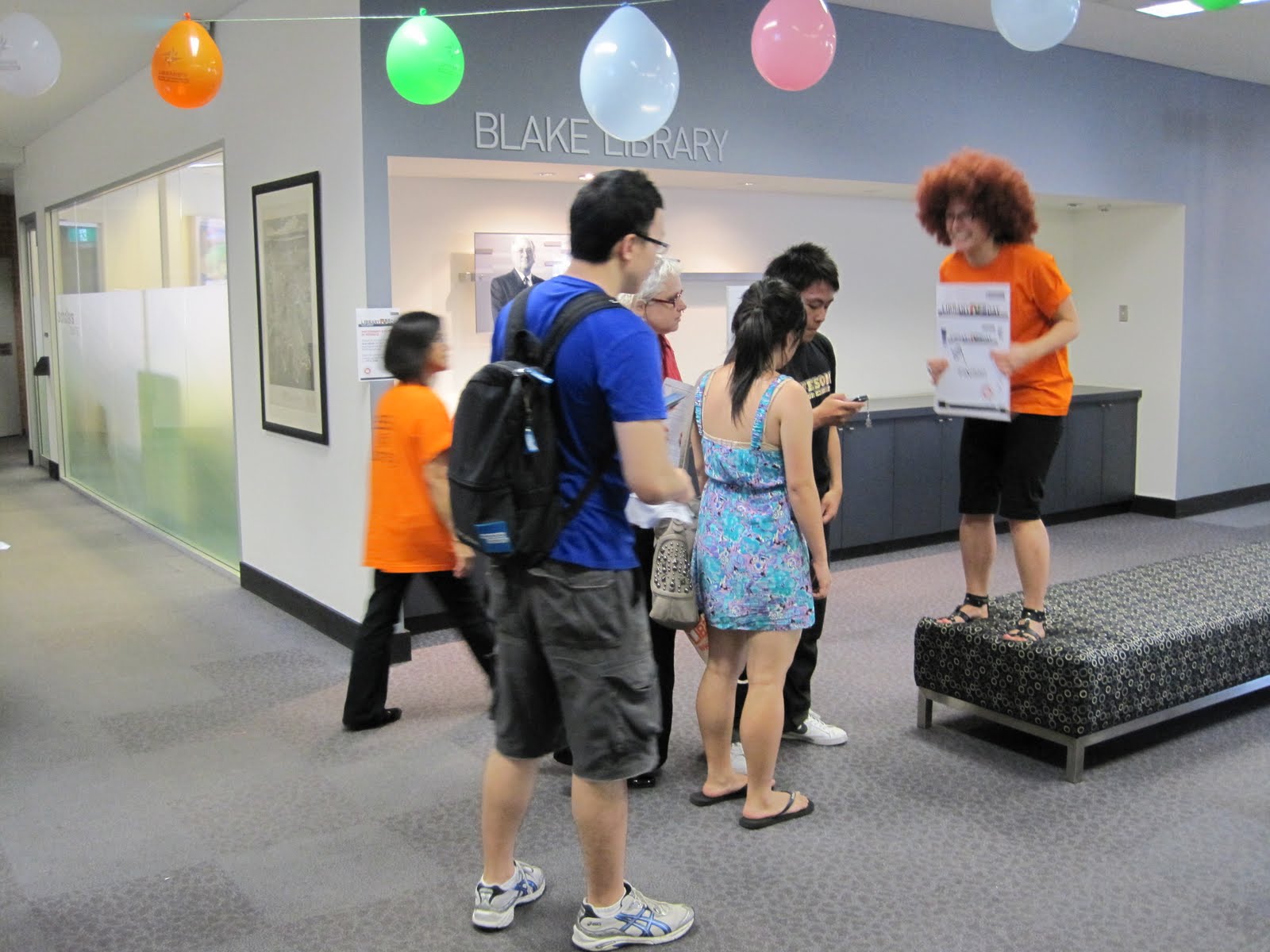
During O week this year we held our inaugural Library Fun Day! And what a day of fun it was! There was Wii and Xbox 360 games, library trivia, rogues gallery, free food and drink and a totally awesome library treasure hunt! I really got into the fun spirit of the day as you can see I wore a maroon afro wig and orange T-shirt. This first photo shows people gathering for the first treasure hunt of the day.

I organised the treasure hunt with a little help from my friends (thanks) and gave participants the option of using QR code or paper clues so no one was disadvantaged. We thought most people would have web enabled phones and could download a QR code reader before starting if they didn't already have one. However, we found most people didn't have wifi enabled phones and couldn't utilise the QR code clues (BTW we ran the treasure hunt twice and both winners used the QR code clues)! There were six stations in the treasure hunt and participants had to photograph each station and be first back to claim the prize. The stations were: find the research help desk, find **** in the catalogue, find same book on shelf, take our librarian or not test, become our fan on Facebook and find the printing/copying room.

There was such excitement in the library as everyone scurried up and down the stairs looking for all the stations and clues. At one point @malbooth may have remarked that it was "an OH&S nightmare"! The triumphant winners exclaimed that they'd had so much fun and learnt a lot about the library! In light of this great success we're considering how we can integrate treasure hunts into our usual start of semester tours schedule! Information literacy and fun can be in the same sentence!

Library staff really got into the swing of things by participating in our Meet your Librarians gallery. Before the Fun Day a few of us went around taking photos of co-operating library staff using my iPhone and then manipulated the photos using an iPhone app. The results were so funny that everyone started emailing each other their photos, printing them and putting them up everywhere (see above)! It proved a really fun way to get to know library staff and start a little silliness! Breaking down the perceptions students may have about librarians being all serious and foreboding is a hard task but I think we really achieved this.

We had many goals for the day but I think a real positive to come out of it was students coming to the library, seeing it as a vibrant fun place to be and breaking down preconceptions they might have about libraries/librarians.

It took a team of people, much planning, crazy ideas and enthusiasm to pull off this extravaganza and it was well worth it. We really showed our clients that libraries aren't just about books. We had so many first timers to the library and we overheard many comments from people about how much fun they were having. Can't wait to make it even bigger and better next year!

Monday, November 2, 2009

Into the real world: a day in the life of a new information professional

This is a presentation I did last week for a group of 'Communications - information and media' students. I was part of a 5 person panel and each of us presented a typical day as a recently graduated information professional. There was an interesting and diverse range of careers from librarians to, information architect, online presence consultant and senior knowledge manager.


The students asked us to explain the relevance of our studies to the 'real' world which is somewhat explained in the presentation from my point of view. We each explained different aspects of how theory relates to practice but we all agreed that being able to compare, critically analyse and synthesise theories into practice is a vital skill used on a daily basis. This understanding of theory provides the foundation for understanding our clients/users and the how/what/why of their information behaviour.

They also wanted to know what kind of jobs there will be for them in the future. A tricky one to answer. I suggested that future information professionals will have a lot of flexibility and freedom to pursue their interests and hone their skills in whichever 'job' they happen to have - which is already what I see happening in my own experience. Employers in this field seem to be very encouraging of staff developing skills and interests that can be of use to the organisation. We also suggested that the skills and experience gained at uni will put them in a position to land a future job that may not even exist yet.

My final piece of advice for future information professionals is: constant change means constant learning, continue to play and be curious.